 Laser Cladding Phương Đông
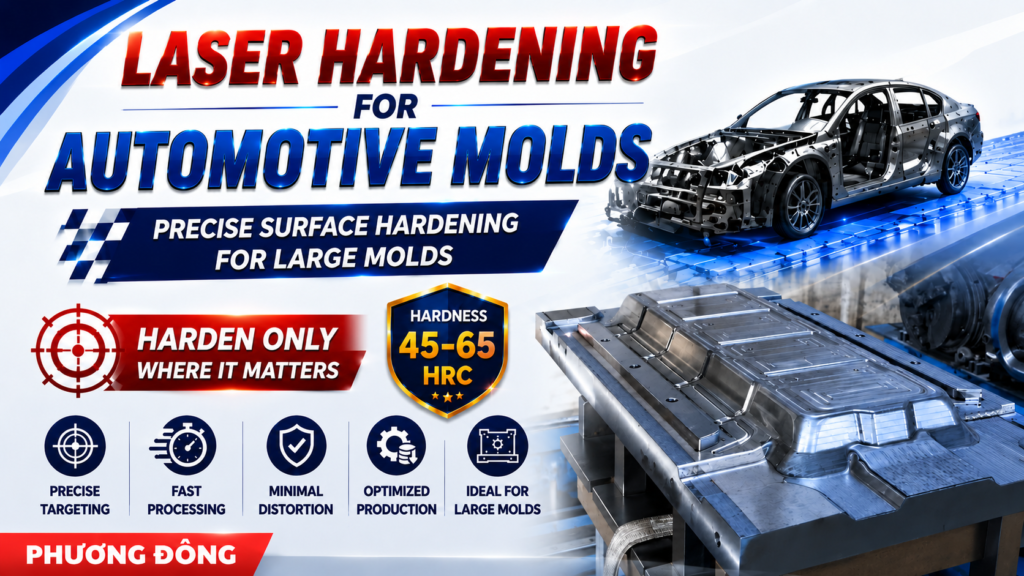
In the automotive industry, stamping dies play a critical role in determining product quality and production efficiency. Because they operate continuously under high mechanical loads, areas such as cutting edges, radii, and forming surfaces are subject to significant wear. These working areas therefore require surface hardening to ensure die durability and stable performance.
For this reason, Laser Hardening (also known as Laser Heat Treatment) is increasingly being adopted as an advanced surface-hardening solution for automotive dies, thanks to its high precision, fast processing speed, and minimal distortion.
Challenges of Conventional Hardening Methods for Automotive Dies
Currently, common surface-hardening methods for automotive dies include furnace heat treatment, induction hardening, and nitriding. Each technology has its own advantages; however, applying them to large or complex automotive dies can present several challenges.
With furnace heat treatment, the entire die must be heated to the required treatment temperature. For large dies weighing several tons, this requires a furnace with substantial dimensions and heating capacity. The heating and cooling processes can also take considerable time. After heat treatment, additional finishing machining is often required to restore the required dimensional accuracy before the die can be put into production.
Induction hardening offers a relatively fast processing speed, but its ability to harden complex surfaces or difficult-to-access areas can be limited.
Meanwhile, nitriding can produce a hard and wear-resistant surface layer, but the treatment process typically requires several hours or even tens of hours, depending on the required case depth and specifications.
More importantly, not every area of an automotive die requires high hardness. Only the working areas that are exposed to significant wear need to be hardened. Hardening the entire die can therefore increase processing time, energy consumption, and manufacturing costs without providing proportional benefits.
This is one of the key reasons why Laser Hardening is gaining increasing attention in modern die manufacturing.
What Is Laser Hardening?
Laser Hardening, also known as Laser Heat Treatment, is a surface-hardening technology that uses a high-power laser beam to precisely heat the surface layer of steel to its hardening temperature.
As the laser beam moves away, the heated area rapidly self-cools through heat conduction into the surrounding bulk material, without requiring water or oil quenching. This process forms a martensitic layer with a hardness of approximately 45–65 HRC, improving wear resistance and extending die service life.
Because the process is concentrated primarily in the surface layer, the core of the material retains its original structure and mechanical properties. At the same time, the very small heat-affected zone helps significantly reduce distortion and deformation after treatment.
Advantages of Laser Hardening for Automotive Dies
Compared with conventional hardening methods, Laser Hardening offers several key advantages:
- Hardens only the required working areas.
- Surface hardness of approximately 45–65 HRC.
- Improves wear resistance and extends die service life.
- Very small heat-affected zone, minimizing distortion and deformation.
- Significantly reduces the amount of post-treatment machining.
- Fast processing speed, suitable for modern manufacturing.
- CNC or robotic control provides high precision and repeatability.
- Particularly suitable for large and complex automotive dies.
Comparison of Laser Hardening with Conventional Methods
| Criteria | Furnace Heat Treatment | Induction Hardening | Nitriding | Laser Hardening |
|---|---|---|---|---|
| Treatment area | Entire die | Localized | Entire surface | Only required areas |
| Processing time | Long | Fast | Very long | Fast |
| Risk of distortion | High | Medium | Low | Very low |
| Post-treatment machining | Often required | May be required | Limited | Significantly reduced |
| Suitability for large dies | Limited | Limited | Limited | Excellent |
| Automation | Medium | Medium | Low | High |
By hardening only the areas that actually require increased wear resistance, Laser Hardening can shorten production time, reduce energy consumption, and optimize manufacturing costs. This makes it particularly effective for large automotive dies and applications requiring high dimensional accuracy.
Applications of Laser Hardening in the Automotive Industry
Laser Hardening can be applied to various dies and components used in automotive manufacturing, including:
- Automotive body stamping dies.
- Cutting dies.
- Punching dies.
- Forming dies.
- Pressing punches and dies.
- Mechanical components subject to high wear.
Beyond the automotive industry, the technology can also be applied to industrial dies, household-product molds, electronic component molds, packaging molds, punches, dies, forming tools, and various mechanical components requiring high wear resistance.
Laser Hardening Services at Phuong Dong
With extensive experience in laser technology, Phuong Dong provides Laser Hardening (Laser Heat Treatment) services for automotive dies and industrial tooling.
Our modern equipment, combined with CNC and robotic control, enables precise treatment according to the geometry and working areas of each die, meeting demanding requirements for hardness, dimensional accuracy, and process consistency.
We provide technical consultation and recommend suitable treatment solutions based on the material and specific operating requirements, helping customers extend die service life, reduce maintenance costs, and improve production efficiency.
Contact us for consultation and quotation:
PHUONG DONG INDUSTRIAL AND TRADING CO., LTD
Address: Alley 107, Ga Dong Anh Street, Group 8, Thu Lam Commune, Hanoi, Vietnam
Phone/Zalo: +84 987 822 360