 Laser Cladding Phương Đông
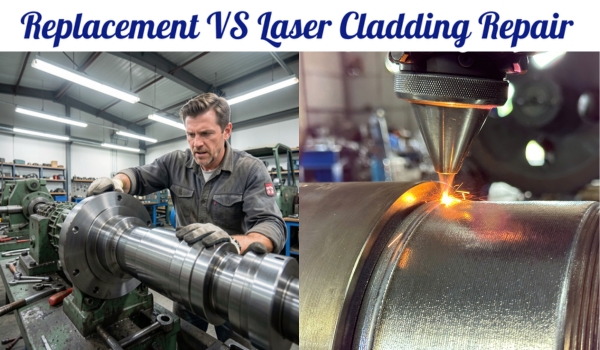
During industrial operation, many mechanical components wear out or become damaged over time. In such cases, companies must decide between Laser Cladding repair and manufacturing a new part.
In many situations, Laser Cladding is a more economical and efficient solution than full replacement.
Laser Cladding restores the original dimensions of worn components by depositing a high-strength alloy layer, allowing the equipment to continue operating reliably without manufacturing a new part.
Choose Laser Cladding for High-Value Components
Laser Cladding is especially suitable for components with high value or high manufacturing cost, such as:
- Industrial shafts
- Generator rotor journals
- Rollers
- Screw conveyors
- Large gears
- Bushings and sleeves
These components often involve high production costs and long lead times. Laser Cladding repair can significantly reduce costs compared to replacement.
Choose Laser Cladding for Localized Damage
Many components wear only at specific locations while the rest of the part remains in good condition, such as:
- Worn shaft journals
- Worn shaft surfaces
- Bearing seats
- Flanges
- Bushings and sleeves
In these cases, Laser Cladding allows precise restoration of the worn areas without replacing the entire component.
Choose Laser Cladding to Reduce Downtime
Replacing components often requires manufacturing or importing new parts, which can take weeks or even months.
Laser Cladding helps reduce repair time because:
- No need to order new parts
- No international shipping required
- Repair can be completed locally
This is especially important for continuous production systems.
Choose Laser Cladding to Extend Component Life
In many cases, Laser Cladding not only restores components but also improves their service life.
Laser Cladding coatings can be designed to:
- Improve wear resistance
- Improve corrosion resistance
- Increase surface hardness
As a result, repaired components can sometimes perform better than untreated new parts.
When Replacement Is Better Than Laser Cladding
Although Laser Cladding has many advantages, it is not suitable for every situation. Replacement is recommended when:
- Severe cracking is present
- Large deformation occurs
- Base material mechanical properties are degraded
- Structural damage is significant
In these situations, replacement provides better safety and reliability.
Comparison: Laser Cladding vs Replacement
| Criteria | Laser Cladding | Replacement |
|---|---|---|
| Cost | Usually lower | Higher |
| Lead time | Faster | Longer |
| Local repair | Yes | No |
| Service life improvement | Possible | Not always |
| Import dependency | No | Possible |
Laser Cladding is usually the best option when the component structure remains sound and only surface wear has occurred.
Conclusion
Laser Cladding should be selected when mechanical components are valuable, locally worn, or require fast restoration to minimize downtime.
In many cases, Laser Cladding reduces both repair costs and lead time compared to replacement.
With its ability to produce high-strength coatings and precise dimensional restoration, Laser Cladding is an effective solution for industrial maintenance and component refurbishment.
Contact us for consultation and quotation:
PHUONG DONG INDUSTRIAL AND TRADING CO., LTD
Address: Alley 107, Ga Dong Anh Street, Group 8, Thu Lam Commune, Hanoi, Vietnam
Phone/Zalo: +84 987 822 360