 Laser Cladding Phương Đông
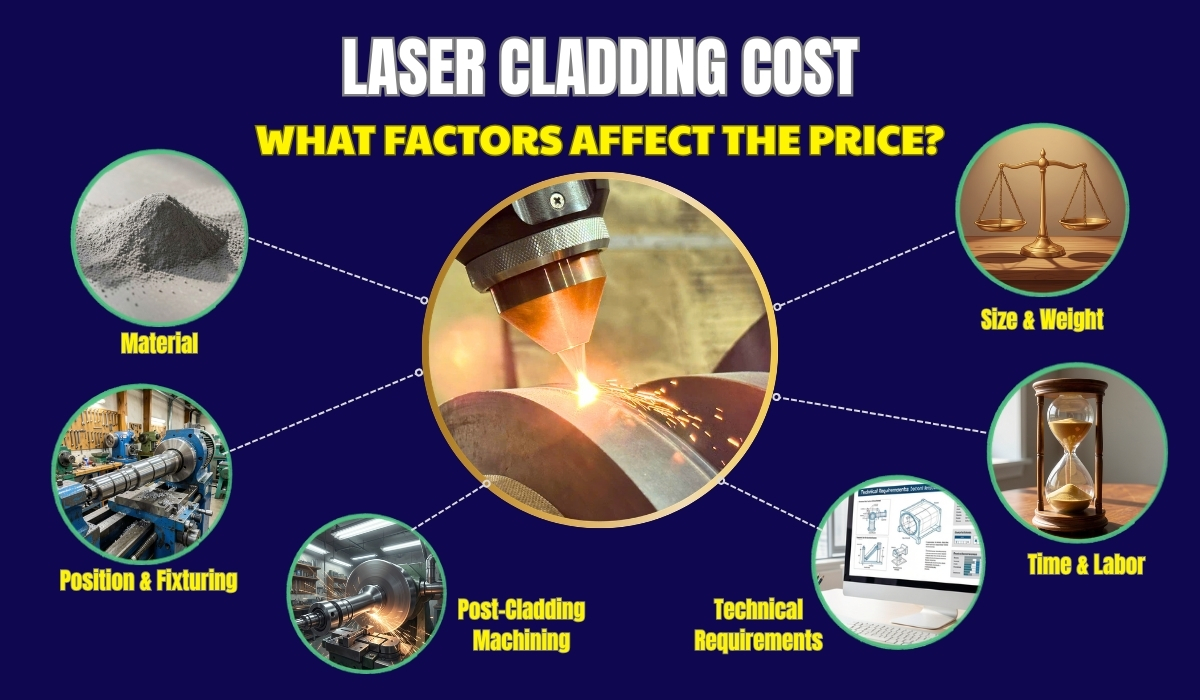
The cost of Laser Cladding services can vary depending on the type of component, cladding material, and technical requirements. Unlike many conventional repair methods, Laser Cladding cost is usually calculated based on multiple technical factors rather than a fixed price.
Understanding the factors that affect Laser Cladding cost helps companies estimate repair budgets and choose the most suitable solution.
Main Factors Affecting Laser Cladding Cost
Laser Cladding cost usually depends on the following main factors:
- Size and weight of the component
- Wear condition of the component
- Cladding surface area
- Cladding position and fixturing complexity
- Cladding powder material
- Technical requirements after cladding
- Post-cladding machining
- Lead time
- Quantity of components
Below are the detailed explanations of each factor.
1. Size and Weight of the Component
The size and weight of the component are among the most important factors affecting Laser Cladding cost. Large or heavy components usually require:
- Longer cladding time
- More cladding material
- Longer setup and alignment time
- Lifting equipment such as overhead cranes or forklifts
- Heavy-duty machining equipment and workspace
For long or heavy components, handling and positioning are often more complicated, which increases the overall cost.
Example: Long shafts or large-diameter shafts typically have significantly higher costs than small components due to lifting requirements and longer processing time.
2. Wear Condition of the Component
The level of wear directly affects the repair cost. Severely worn components usually require:
- Thicker cladding layers
- Multiple cladding passes
- Longer machining time
Components with minor wear usually have lower repair costs.
3. Cladding Surface Area
Laser Cladding cost strongly depends on the surface area that needs to be restored. Larger cladding areas require:
- More material consumption
- Longer cladding time
- Higher cost
In many cases, local repair is more economical than full-surface cladding.
4. Cladding Position and Fixturing
Cladding position and component geometry also affect Laser Cladding cost. Depending on the size, geometry, and cladding location, suitable fixtures are required to ensure stability and accuracy during cladding.
Some cases may require:
- Dedicated fixtures for specific components
- Custom-made fixtures
- Multiple alignment adjustments
Difficult cladding positions such as:
- Internal bore cladding
- Pipe internal cladding
- Deep or narrow areas
- Complex surfaces
often require specialized cladding heads or laser optics, increasing preparation and processing costs.
5. Laser Cladding Powder Material
The type of cladding powder is one of the most important factors affecting Laser Cladding cost. Each alloy powder has different compositions and properties suited for different working conditions.
In practice, many types of metal powders can be used in Laser Cladding, such as:
- Stainless steel powders for corrosion resistance
- Iron-based alloys for wear resistance
- Nickel-based alloys for high-temperature and oxidation resistance
- Cobalt-based alloys for high wear and heat resistance
- Tungsten carbide (WC) powders with very high hardness
- Babbitt alloys for bearing repair
- Aluminum alloys
- Copper alloys
- Special alloys upon request
Different powders have different costs. High-performance materials such as nickel-based alloys (Inconel 625, Inconel 718), cobalt-based alloys (Stellite 6, Stellite 12), and tungsten carbide powders are usually more expensive than standard alloys.
In addition, the powder material also affects post-cladding machining cost. Materials with high hardness or high toughness are more difficult to machine, increasing turning or grinding time.
Therefore, Laser Cladding cost depends not only on powder price but also on machining difficulty after cladding.
6. Technical Requirements After Cladding
Technical requirements also significantly affect Laser Cladding cost, such as:
- High dimensional accuracy
- Fine surface finish
- Hardness testing
- Non-destructive testing (NDT)
Higher technical requirements increase both machining time and inspection cost.
7. Post-Cladding Machining
After Laser Cladding, components usually require finishing operations such as:
- Turning
- Grinding
- Polishing
More complex machining leads to higher cost.
8. Lead Time
Delivery time can also affect the cost. Urgent orders often require:
- Machine priority
- Overtime work
- Production schedule adjustments
As a result, urgent jobs may have higher costs than standard orders.
9. Quantity of Components
Quantity is another factor affecting the unit cost. Processing multiple identical components helps:
- Reduce setup time
- Optimize production
- Lower cost per component
Single-piece repairs usually have higher costs.
Conclusion
Laser Cladding cost depends on many factors such as component size, wear condition, cladding area, cladding position, powder material, technical requirements, and post-cladding machining.
Since every component has different technical characteristics, Laser Cladding cost is usually calculated individually. Proper evaluation helps select the most suitable Laser Cladding solution and optimize repair cost.
Contact us for consultation and quotation:
PHUONG DONG INDUSTRIAL AND TRADING CO., LTD
Address: Alley 107, Ga Dong Anh Street, Group 8, Thu Lam Commune, Hanoi, Vietnam
Phone/Zalo: +84 987 822 360