 Laser Cladding Phương Đông
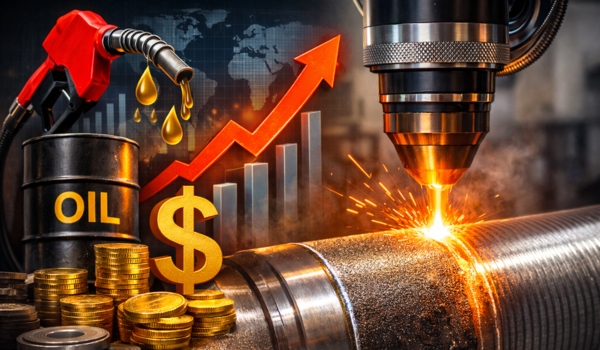
In recent days,, global fuel prices have shown a strong upward trend due to various political and economic factors. One of the most significant causes is the growing geopolitical tension and military conflicts in the Middle East, particularly involving the United States, Israel, and Iran. These developments not only affect the global energy market but also have a direct impact on production and service costs across many industries, including mechanical component repair services using Laser Cladding technology.
Oil Prices Increase Due to Tensions in the Middle East
Conflicts involving the United States, Israel, and Iran have raised concerns about potential disruptions in oil supply from the Middle East, a region that provides a significant portion of the world’s energy. According to market analyses, crude oil prices have risen sharply in a short period when military actions intensified and the risk of supply disruption through the Strait of Hormuz increased.
The Strait of Hormuz is one of the world’s most important oil transportation routes, responsible for nearly 20% of global oil shipments. Any disruption in this region can cause significant volatility in the global energy market.
During periods of escalating conflict, rising oil prices place substantial pressure on energy costs and contribute to global inflation.
Impact on Transportation Costs in Industry
When fuel prices increase, transportation costs for equipment, materials, and mechanical components also rise. In the field of mechanical repair and refurbishment, many large components such as:
- Industrial shafts
- Generator rotors
- Hydropower turbine runners
- Cement industry rollers
- Other large mechanical components
often need to be transported from the customer’s factory to the repair facility. As fuel prices increase, logistics costs rise accordingly, which leads to higher overall costs for repair services.
Increasing Energy and Operational Costs
Laser Cladding technology relies on high-power laser systems along with supporting equipment such as control systems, cooling systems, alloy powder feeders, and post-processing machining equipment.
When fuel prices increase, other energy-related costs often follow the same trend. This results in higher operational costs for running laser cladding systems, which directly affects the overall service pricing.
Rising Cost of Cladding Materials
Another factor affected by rising energy prices is the cost of cladding materials. The alloy powders used in Laser Cladding processes go through several stages including mining, metallurgical processing, manufacturing, and transportation.
When fuel and energy costs rise, the production cost of these materials also increases. As a result, the input material costs for Laser Cladding repair services become higher.
Pressure to Adjust Laser Cladding Service Prices
Due to simultaneous increases in transportation, energy, and material costs, companies providing Laser Cladding repair services may need to adjust service prices in order to maintain operational efficiency.
However, compared with manufacturing new components or fully replacing damaged parts, Laser Cladding repair remains a cost-effective solution for many industries. This technology allows worn components to be restored to their original dimensions while improving wear resistance and extending equipment lifespan without replacing the entire part.
Conclusion
Fluctuations in oil prices caused by geopolitical factors, particularly tensions in the Middle East, are significantly impacting many sectors of the global economy. For industries involved in equipment repair and refurbishment, rising energy and logistics costs are directly influencing service pricing.
Despite these challenges, Laser Cladding technology continues to be an effective solution for reducing maintenance costs, extending component lifespan, and minimizing the need for new part replacements, especially during periods of volatile energy and raw material prices.